Steps Ventures · Digital Editions — in collaboration with Andrew Otis
Calcutta, 1780:
the Court and the Press
A digital edition reuniting two archives written side by side in the same city and decade — a Supreme Court judge's notebooks, and the first newspaper printed in India.
Overview
In the 1780s, two records of Calcutta were being written at once. On the bench, Justice Sir John Hyde filled notebook after notebook with the proceedings of the Supreme Court of Judicature at Fort William. A few streets away, James Augustus Hicky set type for Hicky's Bengal Gazette — until the government he needled dragged him into that very court.
Both records survived, but barely, and apart: the notebooks as tens of thousands of hard-to-read manuscript pages, the newspaper as fragments scattered across seven libraries on four continents, with no complete run anywhere. This edition transcribes the notebooks in full, reconstructs the newspaper from its surviving pieces, and — because the two overlap in 1780–1782 — connects the press record to the court record for the first time. The historical scholarship and direction are Andrew Otis's, author of Hicky's Bengal Gazette: The Untold Story of India's First Newspaper; the transcription and reconstruction were done with AI, page by page, against the original images.
I. The Hyde Judicial Notebooks, 1777–1798
| ~22,400 | manuscript pages, now transcribed end to end |
| ~4,100 | pages recorded as "blank" that in fact held full court records |
| 12,785 | earlier human transcriptions re-checked against the original images |
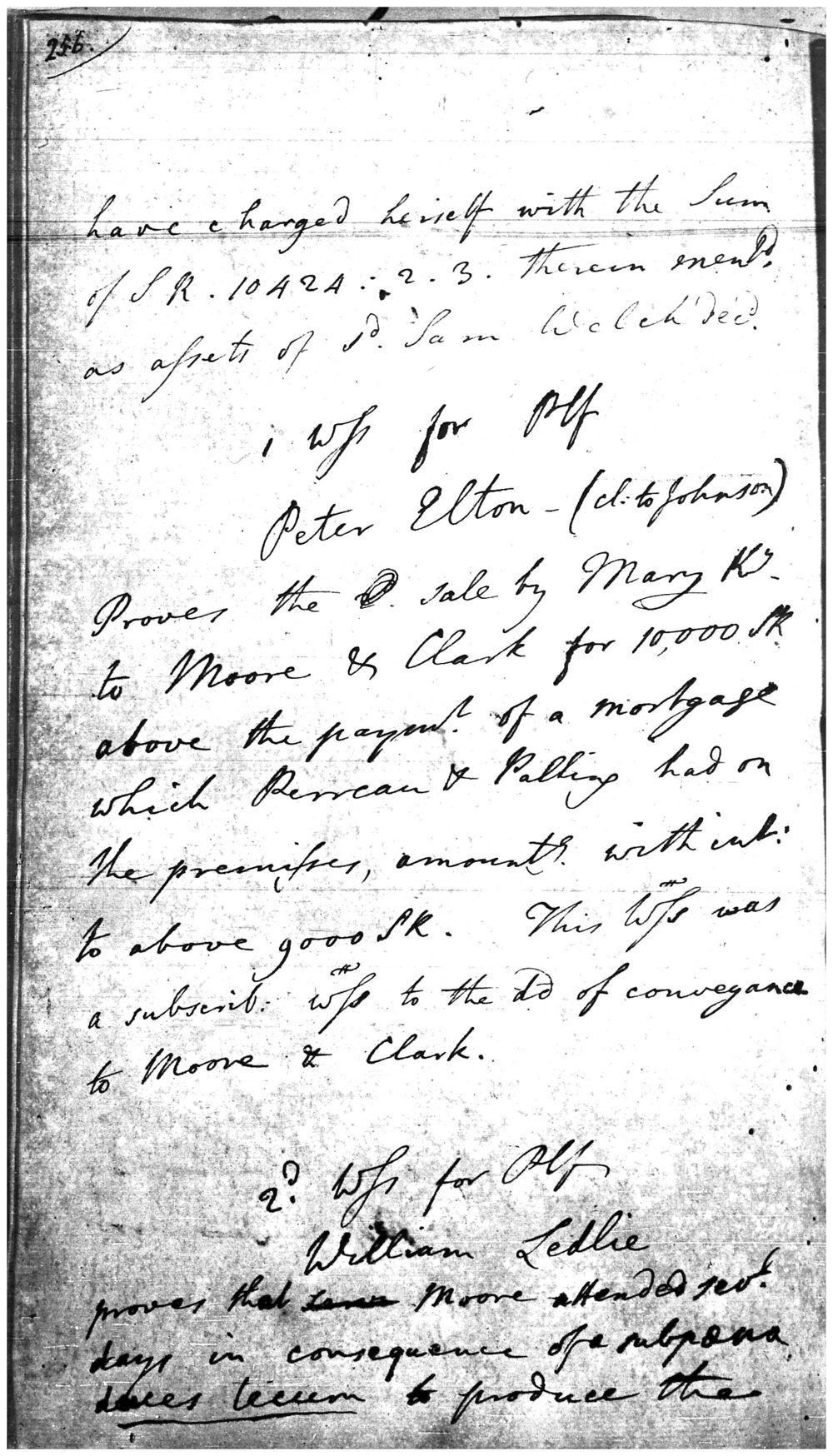
The notebooks were read cover to cover. The project's quiet surprise lay in the pages earlier efforts had marked empty — carrying only a page number. Read again, image by image, thousands of them proved to be dense with pleadings, answers, and testimony; roughly four thousand pages of text, long presumed blank, were recovered. Every existing human transcription was then collated against its photograph, producing a corrected reading and a list of variant readings for each page — a second, machine-checked layer over a hand-made one, so a scholar can see exactly where the eye and the algorithm disagree.
II. Hicky's Bengal Gazette, 1780–1782
| 121 / 122 | surviving issues, reconstructed into one edition |
| 7 | library collections collated — none complete on its own |
| 1 | issue lost in every collection (6 January 1781) |
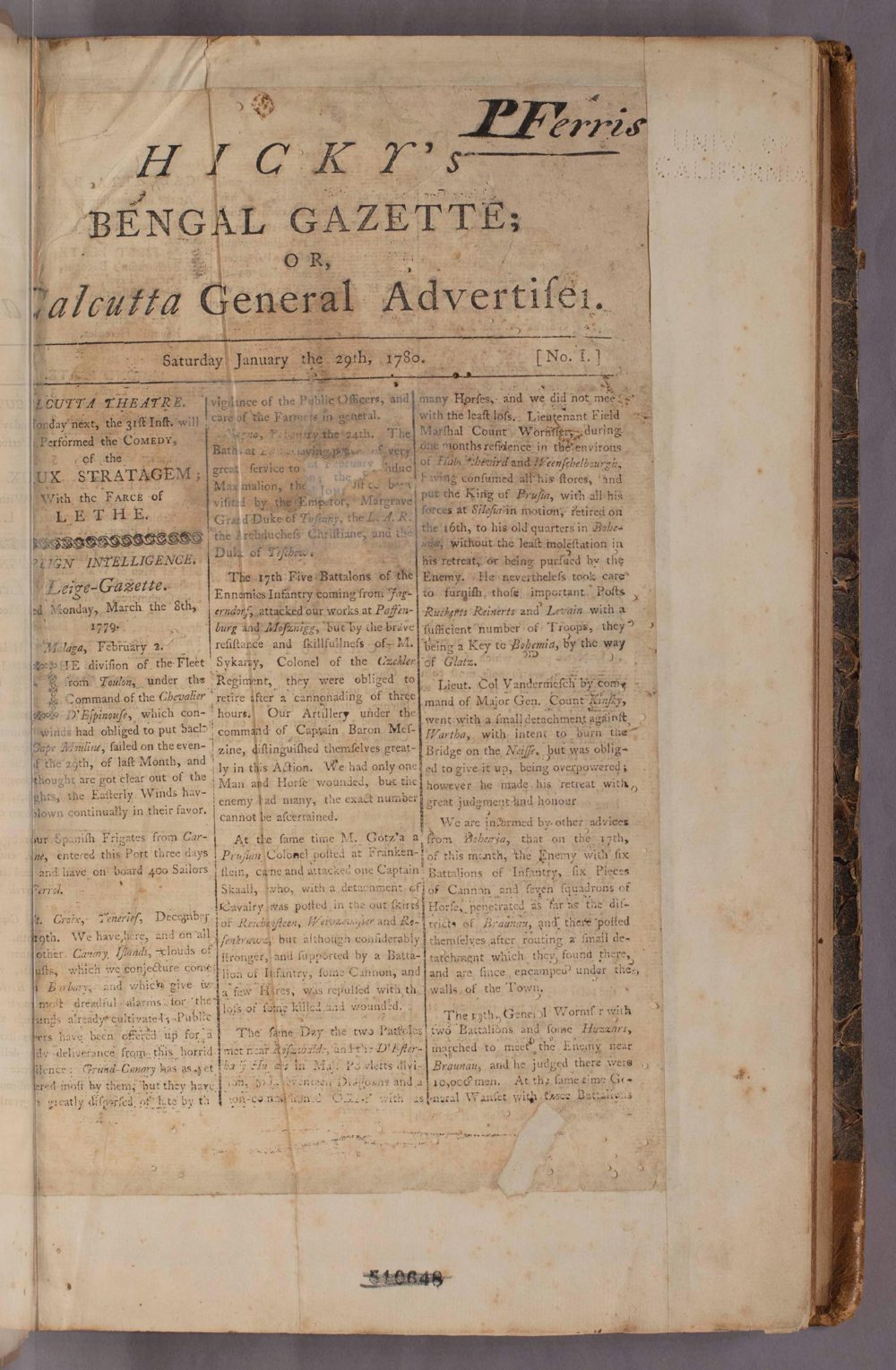
No library holds a whole run of the Gazette. By collating the seven that survive — the British Library, the National Library of India, Berkeley, Heidelberg, Melbourne, and the High Court of Calcutta — and transcribing each page from the clearest surviving photograph, the edition assembles the most complete version of the paper in existence. It restores the very first issue (above), the Prospectus Hicky circulated before launch, and the final issue of March 1782 — none of which had been transcribed before. A second, image-corrected edition then re-reads every page against its photograph and records each correction, so the text can be trusted down to the word.
III. A Discovery — the Press meets the Bench
Because the two archives cover the same years, the same events appear in both, seen from opposite benches. Searching the court notebooks for the people and cases named in the newspaper drew a direct line between them: James Augustus Hicky appears across 157 pages of Hyde's notebooks, concentrated in 1781 and 1782 — the years of his prosecution. The judge's private notes preserve the libel charge brought by Governor-General Warren Hastings, the setting of the trial, and even Hicky's own words in the dock; the Gazette preserves the public defiance that provoked all of it. The same method maps Hastings, Impey, Chambers, Jones, Francis, and Nandakumar across both archives at once.
The court record keeps the procedure; the press record keeps the performance. Reunited, each fills the other's silences.
Read the work
Open to read. Hosted as Google documents; you may need this page's share link.
The newspaper as continuous reading text, in chronological parts: I · II · III · IV · V · VI (Prospectus 1780 → March 1782)
Building the corpus — what comes next
This edition is a spine, not an endpoint. Hyde's notebooks and Hicky's Gazette give us the court and the press of one city in one decade. The next phase extends that spine outward into the handwritten records of the same people and the same events — the correspondence, the Company papers, the war dispatches — almost none of which has ever been transcribed. The aim is a single connected, searchable archive of late-18th-century Calcutta, assembled from material that is today scattered, paywalled, or simply unread. AI transcription makes that feasible at a speed and cost that were impossible a few years ago; the real bottleneck now is access to the images, not the reading of them.
The other judges of the court
Sir William Jones's working papers (NYU), Sir Elijah Impey's papers and Sir Robert Chambers's notebooks (British Library and beyond). These are the men whose rulings fill Hyde's notebooks; their private papers are the other half of the bench.
The political principals and the great trials
The Warren Hastings Papers and the Philip Francis papers (British Library), and the manuscript records around the Nandakumar and Hicky prosecutions. Hastings brought the libel suit against Hicky; Francis was his rival on the Council. Their letters are where the courtroom drama becomes politics.
The East India Company and Calcutta society
The Bengal Judicial Consultations, the Calcutta wills, and the Mayor's Court records. The wills name the very merchants who appear in the Gazette's advertisements and the court's dockets — the connective tissue of the city.
The war the Gazette reported
Sir Eyre Coote's papers (Michigan) and the Royal Navy's ships' logs (Kew) for the 1781–82 campaigns against Hyder Ali and the French fleet. The newspaper's front pages were war news; these are the records behind the headlines.
Why it matters. Each addition lets the same event be read from more than one vantage — the bench, the press, the council chamber, the quarterdeck — and lets a single name be traced across all of them. Done at scale, that cross-referencing is what turns a heap of scattered, unreadable documents into a usable history of a place and a moment that shaped the modern world.
A Note on Method
Transcriptions were produced with Google's Gemini models and checked, page by page, against the original images; for the newspaper, multiple library copies of each issue were collated to settle doubtful readings, and a second pass re-read every page to correct it. The texts are machine-assisted and should be verified against the cited source images before scholarly citation. All source images remain the property of their holding institutions, to whom this work is indebted.